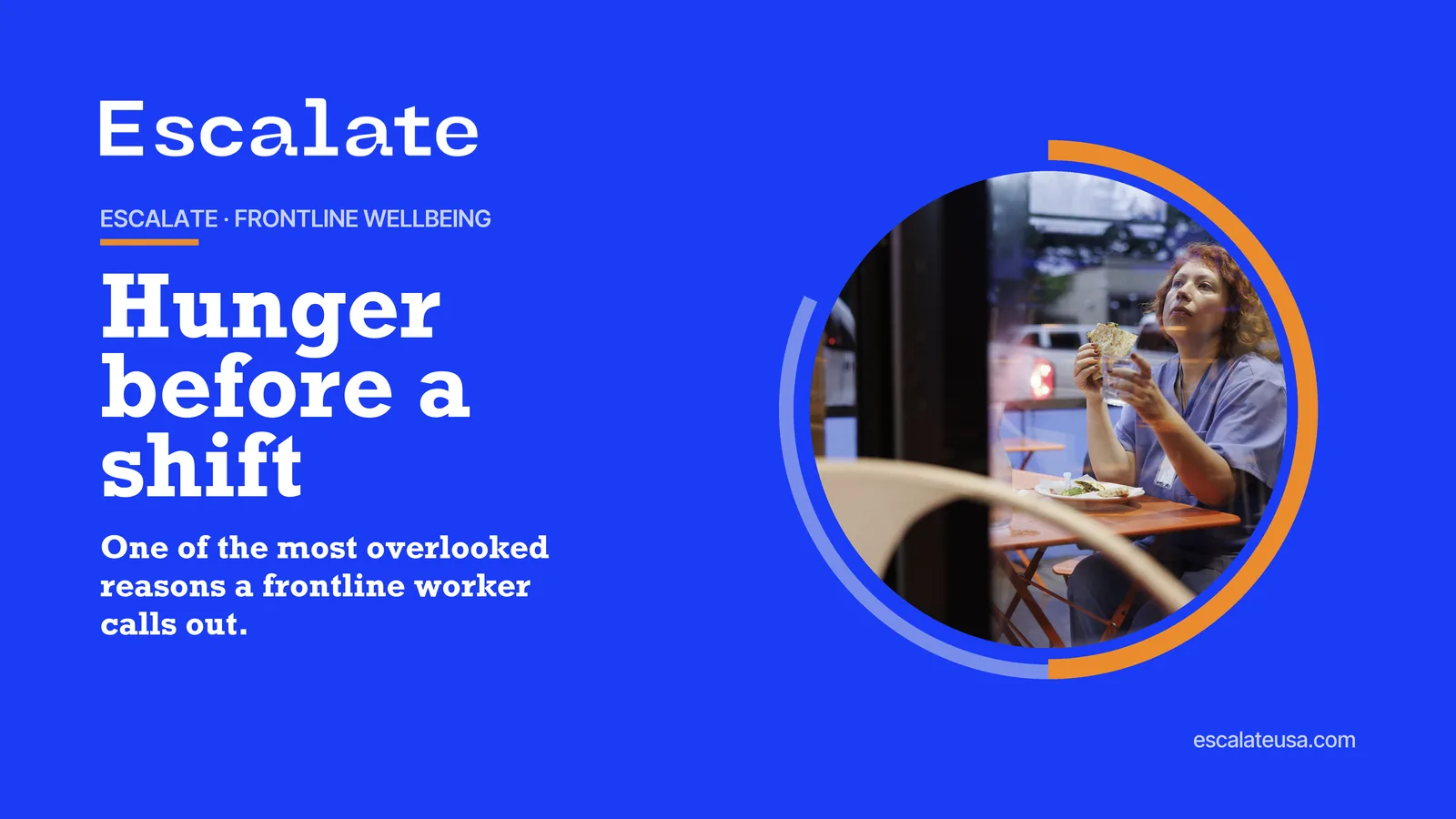
Going hungry makes someone more likely to call out, not less
Food insecurity makes a call-out more likely, not less. You’d expect the opposite: that a worker short on food would go to work, earn the money and buy some.
Someone who has not eaten since yesterday faces eight hours on their feet. That is when they stay home.
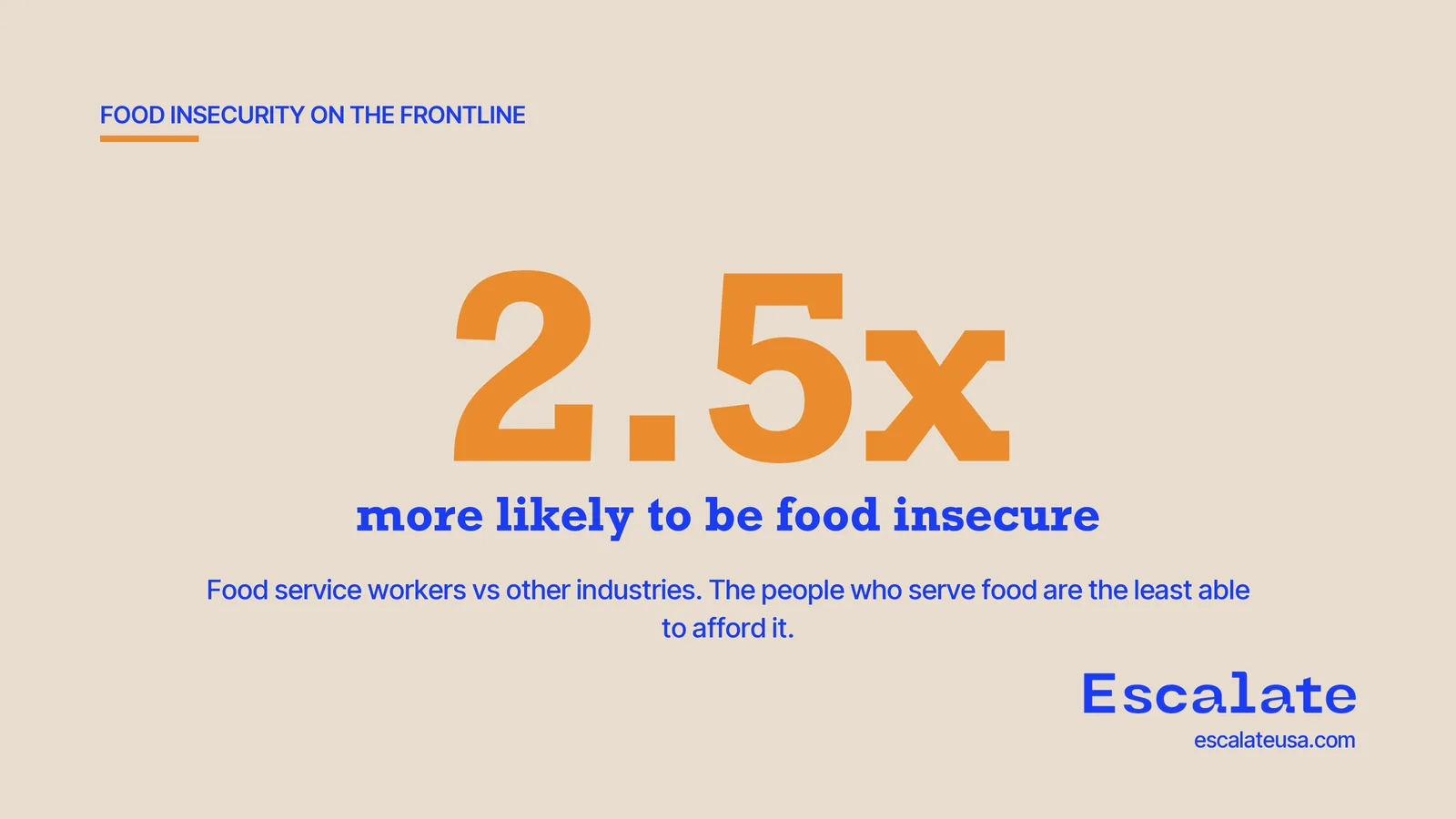
This is common in frontline work. In a study of 5,483 US workers, 8% of those on night and rotating schedules worried about running out of food. Among day workers it was 4%.
Three things turn hunger into a call-out: urgency, lost focus, and worry
Hunger pulls decisions toward now. Hungry people discount the future more steeply. A wage that lands in two weeks weighs less than hunger this morning. That’s the answer to why not just go earn the money and buy food?
Scarcity costs cognitive capacity. The Princeton and Harvard scarcity research found financial scarcity lowers measured cognitive function by roughly a lost night of sleep. Getting to a shift is a planning problem: a ride, childcare, timing and planning is what that capacity buys.
Worry doesn’t switch off. A study in Personnel Psychology found food insecurity lowers job performance and engagement through rumination: a constant background check on whether the next meal is there.
Each call-out makes the next one likelier. The first one is the cheapest to stop.
A call-out means less income. Less income deepens the insecurity. Deeper insecurity makes the next call-out likelier.
A call-out costs a quick-service operator $350, spread across labor, sales and turnover
The same cycle reaches the owner’s P&L. By Escalate’s own data, a single uncovered shift costs a quick-service operator $350, covering the lost sales, the overtime to fill in, the manager’s hour on the phone, and the slower service that follows. None of it appears as a line called “hunger.” It is spread across labor, sales, and turnover, which is why it can run for years without being named. For a franchise owner working on thin margins across several locations, a handful of preventable call-outs a week is the difference between a profitable month and a flat one. The barrier sits with the worker. The cost sits with both.
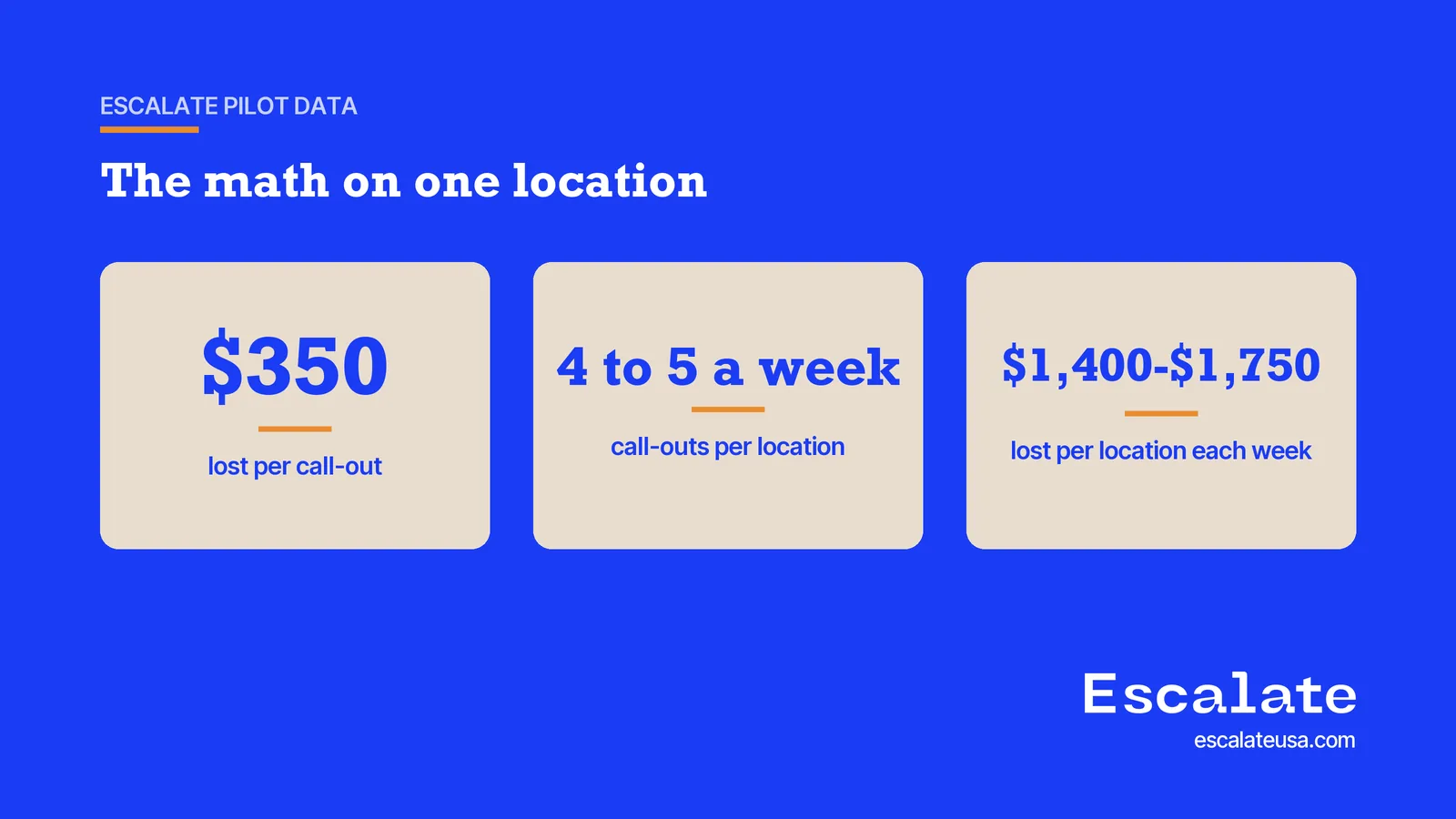
The numbers scale fast. In Escalate’s pilots, restaurants prevented four to five call-outs per location each week. At $350 a shift, that is roughly $1,400 to $1,750 per location each week. Across a ten-location group, the same rate runs to forty or fifty call-outs a week and into the hundreds of thousands of dollars a year.
Turnover is the other half of the same problem, at $2,300 to $2,700 a worker
Absence is only the visible half. The same pressure drives people out. Replacing one hourly worker costs $2,300 to $2,700 in quick service. In retail, up to $14,000. Because each call-out makes the next one likelier, the cost doesn’t stay flat. Left alone it compounds, location by location and month over month.
Most support is introduced at onboarding and forgotten long before anyone needs it
What employers already have in place rarely catches it. Even childcare support which is better established than food support reaches only about 12% of US workers, and 6% of part-time and lower-income staff. Where it exists, it sits in a portal, not in the hand at 6:30am. Most workforce systems are built for hiring and exit, not for the morning a shift is about to be lost.
Food at the moment of need removes the barrier before it becomes a call-out
Targeted support breaks the cycle on both sides. Food delivered at the point of need removes the barrier before it becomes an absence, and research on food provision finds it lowers anxiety. The cost of saving a shift is a fraction of the $350 a lost one takes off the top. The worker keeps the shift and the income. The owner keeps the station staffed and the sale.
Help works when it reaches someone at the moment the problem appears
Not every intervention works, which is why design matters. A randomized trial of free public transit for low-income adults found no measurable effect on hours worked or earnings.
Trigger it at the moment of need, cap it, and tie it to the shift it is for
Trigger it at the moment of need, not on a schedule. Bind it to a purpose, so it closes the gap and nothing else. Cap it. Tie it to the shift, and measure it against shifts saved and sales kept. Support built this way is both harder to misuse and simpler to prove.
FAQ
- Why wouldn’t a worker just come in and buy food after payday? Hunger pulls decisions toward now. A wage two weeks out weighs less than a meal this morning, so the immediate need wins.
- What does one call-out cost a restaurant? About $350, covering the lost sales, the overtime to fill in and the manager’s time. At four to five a week per location that runs to $1,400 to $1,750.
- How would I know whether this is affecting my locations? Ask your managers what the last three call-outs were actually about, and watch for vague reasons. Food rarely gets named out loud, so it shows up as “sick” far more often than as hunger.
- Does this only apply to food? The same pattern runs through transportation and childcare, and transportation is the larger share of requests. Food is the one operators are least likely to have considered.
- How do I stop support like this being misused? Cap each type, tie it to the shift it is for, and route it through someone who can see the pattern. Support built that way is simple to prove and hard to abuse.
References
- Escalate program data, McDonald’s seven-restaurant pilot. Client-provided.
- Storz, Rizzo and Lombardo, shiftwork and food insecurity, International Journal of Environmental Research and Public Health, 2022. NHANES 2007 to 2010, n=5,483.
- Mani, Mullainathan, Shafir and Zhao, “Poverty Impedes Cognitive Function,” Science, 2013.
- Moreno et al, “Working on an Empty Stomach,” Personnel Psychology, 2026.
- Brough, Freedman and Phillips, “Eliminating Fares to Expand Opportunities,” American Economic Journal: Economic Policy, 2023. n=1,797, King County, Washington.
- American Psychological Association, summary of food provision effects on work outcomes.
- Hourly replacement cost in quick service, $2,300 to $2,700. Black Box Intelligence.
- Childcare support reach, 12% of US workers and 6% of part-time and lower-income staff. Source to confirm.
- Retail turnover up to $14,000 a worker. Escalate program data, client-provided. Not attributed to a named account in the copy.