Most call-outs originate in the 90 minutes before the shift starts
Up close, what looks like an attendance problem is usually a logistics one. The worker planned to come in. Then something broke, right before the shift. There was no time to fix it. So the shift was lost.
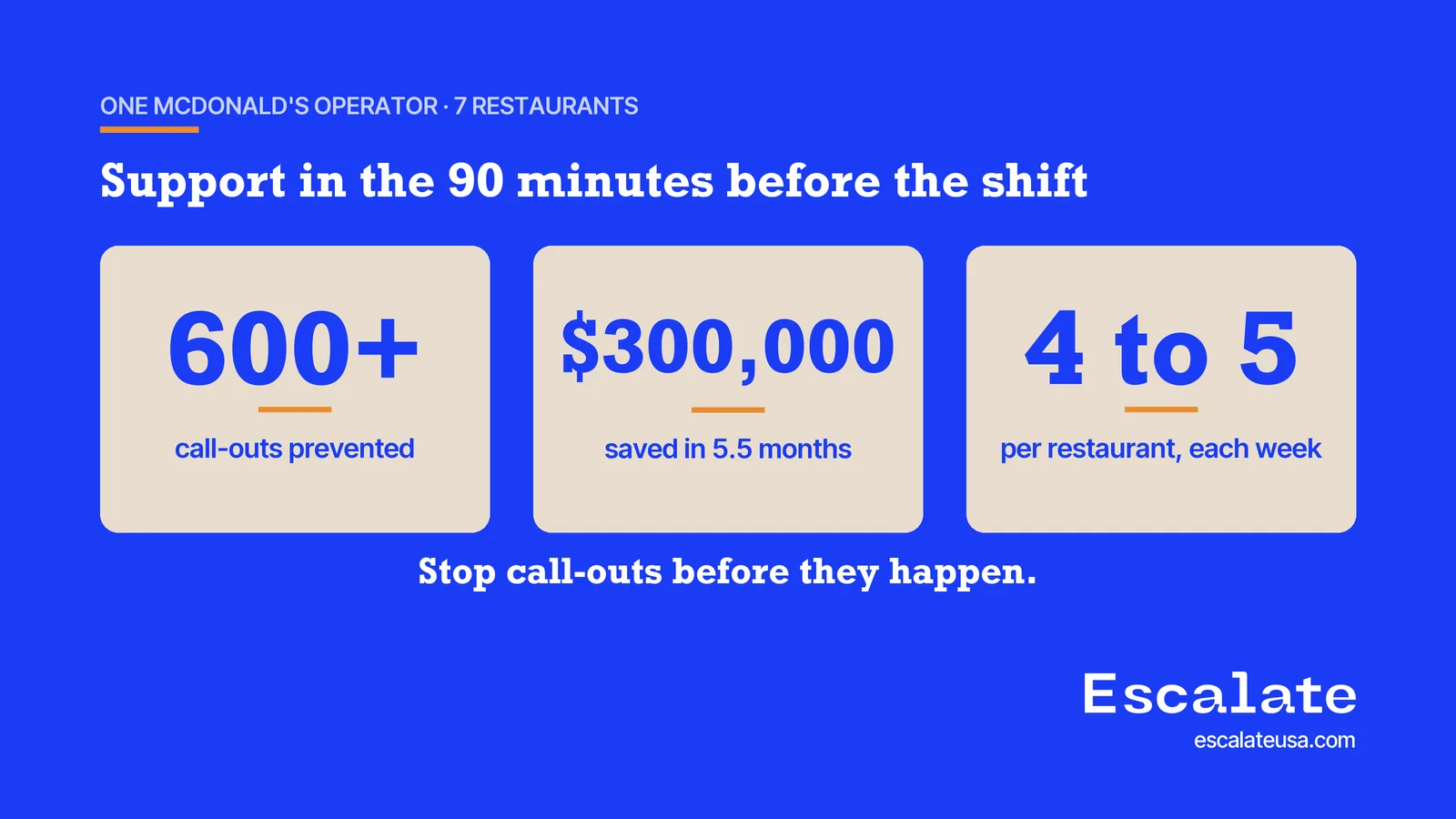
The numbers back this up. One McDonald’s operator ran this across seven restaurants. Support in the 90 minutes before a shift prevented 600+ call-outs, at an average shift worth about $350. The program saved about $300,000, many times what it cost.
A call-out is expensive. A single one runs $150 to $450 (SHRM). On a busy, short-staffed shift it can top $500 (UKG). Those figures cover the overtime to fill in, the sales lost while you run short, the slower service, and the manager’s time.
Transportation causes 81% of frontline support requests
Rides come first by a wide margin. Across seven McDonald’s restaurants, 81% of requests were transportation, 16% food, and 3% childcare.
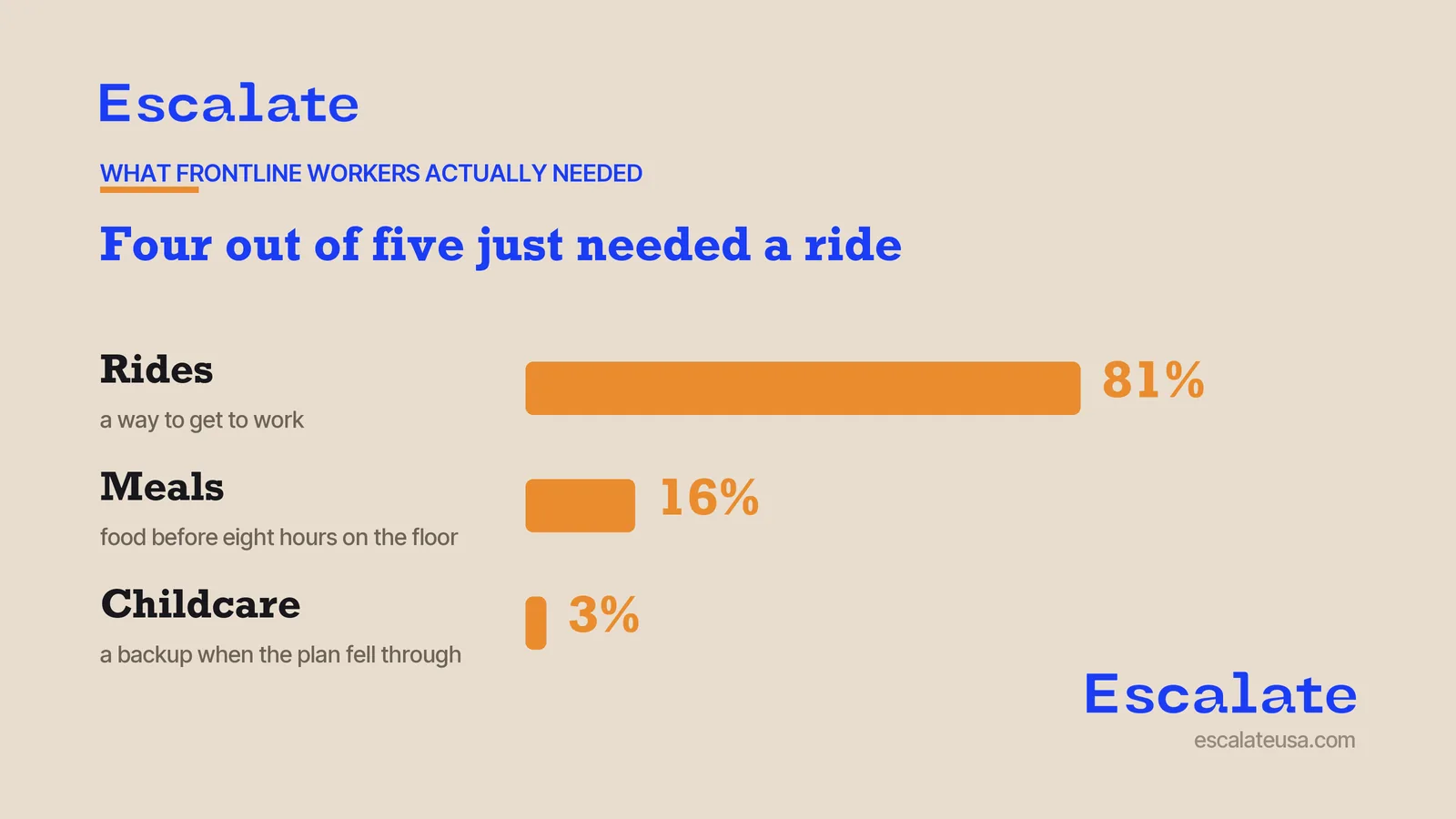
Transportation calls for a ride to work, capped per trip. Food calls for a meal at the start of a shift. Childcare calls for a backup sitter, arranged in advance.
A car will not start. A ride falls through. There is no money for gas before payday. A few cases come down to an unexpected bill or a health issue. Each one costs very little to solve, far less than the call-out it prevents, if you catch it in time.
Most frontline programs are built for the time when workers are already at work
Companies do offer support. It reaches workers in the wrong form and at the wrong time. It sits in a portal from onboarding day. An assistance program, if there is one, often goes unused, because workers rarely hear about it. Desk workers can look things up on a computer. Frontline workers get a break room wall of signs. So the help is there, but not the help that gets someone to their shift, and not at the moment they need it.
Pay advances and telehealth only work if asking is private
Beyond rides, food, and childcare, three more come up often enough to plan for.
- Early access to pay already earned, so an unexpected bill doesn’t cost you the shift.
- A same-day telehealth line, for what doesn’t need an ER but does need an answer by 6am.
- A fast, private way to ask.
That last one is the condition for the rest. A worker won’t raise a childcare crisis or a money problem with the person who writes their schedule, so if the only door runs through the manager, most of them never open it. Plan for the disruptions you can see coming too: weather, school closures. The issues you can spot before they arise never get a chance to hit your bottom line.
93% of supported workers stayed a full year, against a 53% target
A saved shift keeps a worker on the floor today. Do it every week and they stay on the payroll.
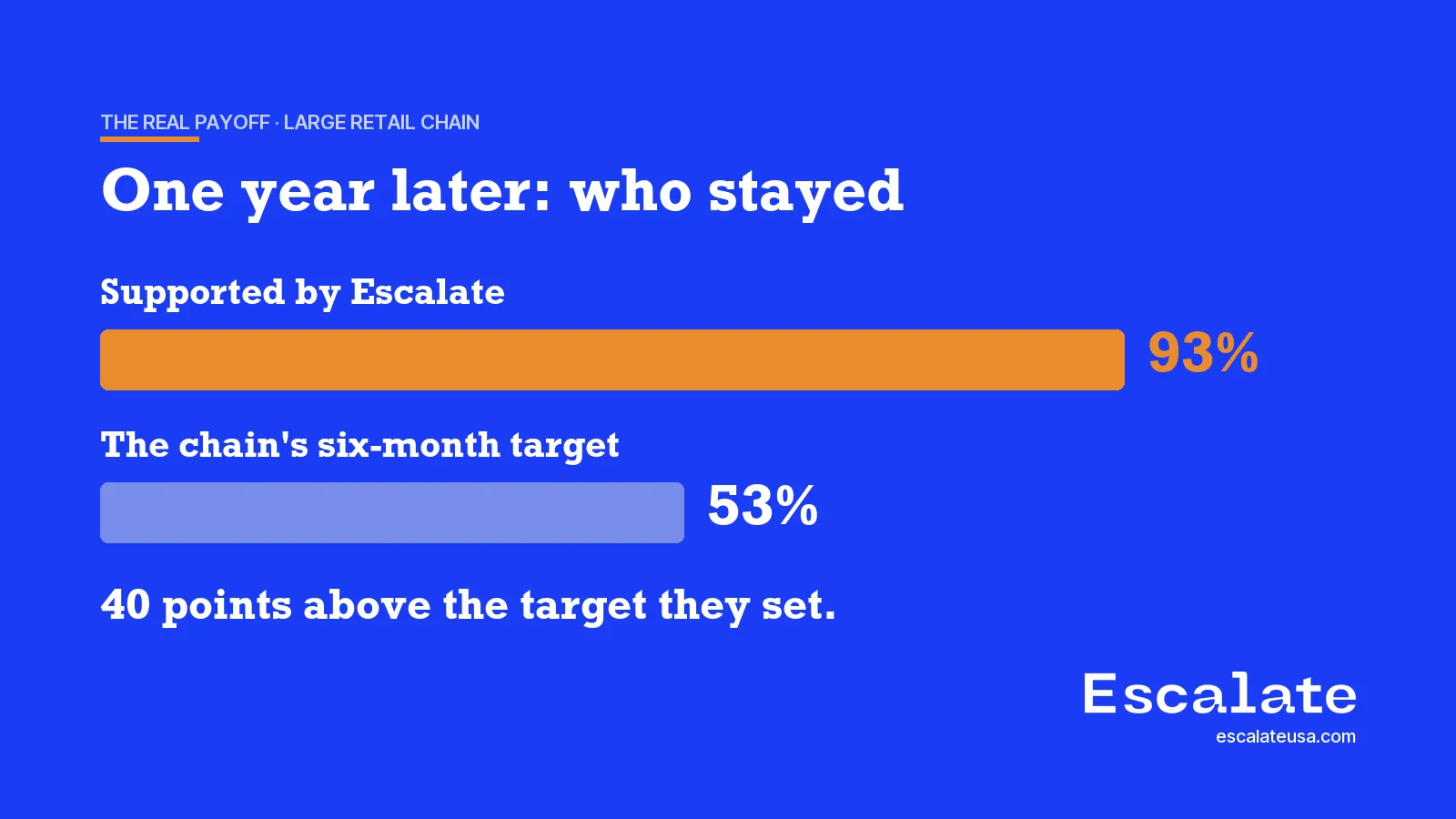
CVS ran a program with Escalate. Supported workers stayed at 93%, against the 53% six-month retention target CVS set. That’s 40 points above their target, from helping people get to work.
Retail turnover can run as high as $14,000 a worker. Across 50 workers, a 40-point lift is 20 people who stayed, as much as $280,000 a quarter, over $1 million a year.
The same holds outside retail. On a multi-national manufacturing company’s factory floor, the same model prevented more than 15 call-outs a month, about $30,000 over five months.
One quick test: if more than 8 in 10 of your call-outs come down to a ride, you don’t have an attendance problem. You have a logistics problem, and the good news is you can plan for that.
Logging every missed shift for a month gives you your own cost per call-out
- Log every call-out and the reason given.
- Mark the ones caused by a ride, an unexpected bill, childcare, food, or health.
- Add up what they cost you. Overtime. Lost sales. Manager time.
A call-out costs the business and the worker. The business spends on overtime and loses sales. The worker loses a day’s pay. Save the shift and neither of them happens.
“It shows a culture of care for your employees. Well above what anyone else is doing.” — Imani Ford, McDonald’s owner
FAQ
- How do I improve frontline worker attendance? Fix the problems that stop people getting to work, in the 90 minutes before the shift. Start with transportation, then food and childcare, and make the help fast and private.
- How do I reduce call-outs? Give workers a quick way to solve a last-minute problem before the shift: a capped ride, a childcare fallback, or a meal. Catch it early, while there is still time to fix it.
- How do I stop frontline workers walking out or quitting? People usually leave over the same barriers that cause call-outs, not the work itself. Remove those and retention rises. In one CVS program it reached 93%.
- What does a call-out cost? A single call-out runs $150 to $450 (SHRM), and $500 or more on a busy, short-staffed shift (UKG).
- What is the pre-shift window? The short stretch, often 30 to 90 minutes before a shift, when a problem comes up but there is still time to fix it.
References
- Escalate program data, McDonald’s seven-restaurant pilot. Client-provided.
- Society for Human Resource Management (SHRM), cost per absence, $150 to $450.
- UKG, cost of an uncovered shift on a busy, short-staffed day, $500 or more.
- Escalate program data, CVS Health retention program. Client-provided.
- Retail turnover up to $14,000 a worker. Escalate program data, client-provided. Not attributed to a named account in the copy.